
Many businesses assume that contractors are responsible for managing their own safety. However, under the Work Health and Safety Act 2020 (WA) (WSH Act), any business that engages contractors has a legal duty to protect their health and safety while they’re performing work for the business. This means employers must still meet WHS requirements when hiring contractors.
What WHS Responsibilities do Employers have when Engaging Contractors?
Under section 19 of the WHS Act, every Person Conducting a Business or Undertaking (PCBU) must ensure, so far as is reasonably practicable*, that the health and safety of workers is not put at risk while work is carried out. This means if a contractor is injured while working for your business and you failed to take reasonable steps to ensure a safe system of work, your business may still be held liable.
*Reasonably practicable means doing everything that a reasonable person in your position would do to minimise risk.
Shared Responsibility, Not Shifted Responsibility
Both you and the contractor have to meet your obligations under the WHS Act. The key difference is that your duties as the PCBU are not transferable, they exist alongside the contractor’s own responsibilities.
In practice, this means:
- You must make sure the work environment is safe and free of known hazards.
- You need to confirm that contractors are competent, properly licensed and have the right equipment.
- You must consult, cooperate and coordinate safety practices with the contractor.
If multiple PCBUs share a worksite, for example, your staff and contractors are working together, you all have overlapping duties and must work together to manage risks.
The following figure shows who may owe duties as PCBU in a contractual chain:
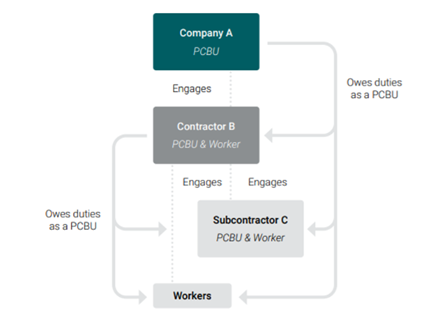
WHS Duties in a Contractual Chain Fact Sheet, Safe Work Australia 2022.
Common Contractor Safety Mistakes
Some of the most common errors that result in compliance breaches include:
- Engaging contractors without checking their insurance or qualifications.
- Not providing an induction, assuming contractors already know what to do.
- Failing to document agreed safety controls or supervision arrangements.
- Treating contractors as fully independent.
How to Set Up a Clear Process for Contractor Compliance?
Managing contractor compliance doesn’t need to be complicated, it just needs to be consistent. Setting up a clear process helps ensure every contractor is engaged safely and legally.
At a minimum, your process should include:
- Pre-qualification checks: confirm insurances, licences and references.
- Site induction: communicate hazards, PPE, emergency plans and reporting procedures.
- Safety documentation: request and review a Safe Work Method Statement or risk assessments for relevant tasks.
- Ongoing monitoring: check in during and after the job to ensure agreed controls are in place.
Taking these steps demonstrates that your business has exercised due diligence, a critical factor if an incident occurs. Keeping records of each step also provides valuable evidence of compliance if your safety practices are ever audited.
If you’d like to learn more about this topic, check out our Let’s Chat HR & Safety podcast, episode 18: Let’s Chat Contractor Safety: Who’s Responsible.
How ProcessWorx Can Help
ProcessWorx works with businesses to make contractor safety practical and transparent. Through ProcessWorxShield, you can:
- Store and track contractor documents and insurances in one place.
- Record inductions and training completion.
- Monitor safety compliance across multiple sites or projects.
- Keep a clear audit trail for regulators.
By taking a proactive approach to contractor management, you not only meet your WHS duties, you also protect your reputation and create a safer, more efficient workplace.
If you’d like to learn how ProcessWorx can assist with Work Health & Safety, please contact us on 08 9316 9896 or enquiries@processworx.com.au. Also watch an Introduction to ProcessWorx.
Follow ProcessWorx on LinkedIn, Facebook, Instagram, YouTube, and X to keep up with the latest HR and Safety news.